
Project example: a maintenance recoat on a 1,500 sq ft retail floor — what happens and what it costs
Hardwood Floors Oak Torrance walks through a typical job in a West Torrance shop: about 1,500 square feet of wood floor with wear paths, given a maintenance screen and recoat after hours in two zones.
Bookings aren't open yet. Leave your name and number; your message is recorded, and you'll get one message when a local installer is available.
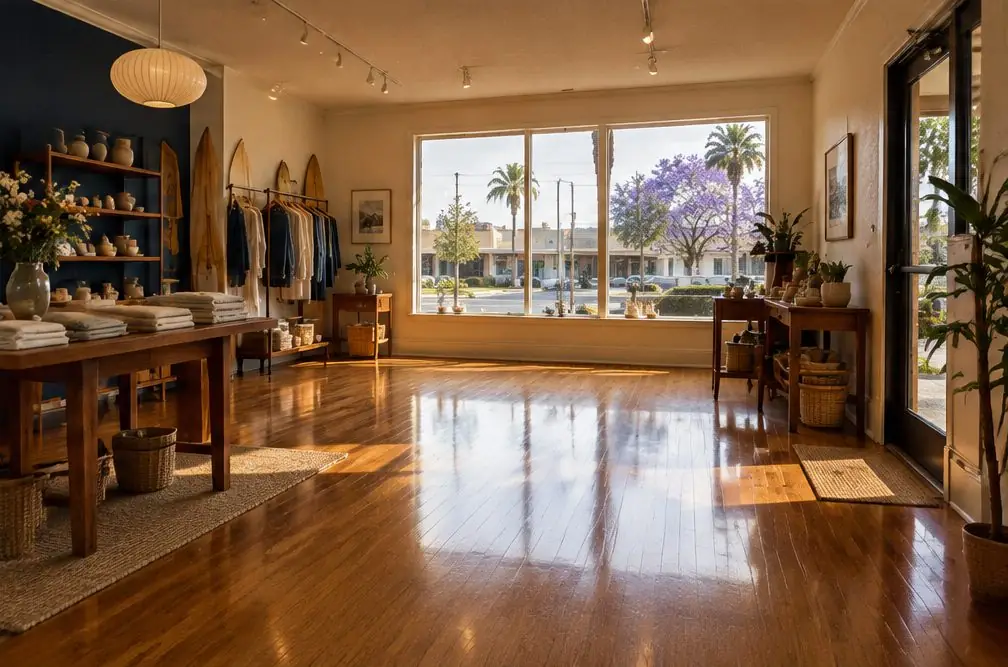
Worked example. The pictures are AI concept illustrations, not photographs; no installation was performed or arranged through this site; prices are typical Torrance area market ranges, not quotes.
 Illustration
Project Examples & Typical Prices
The scenario
Picture a clothing shop in a strip of storefronts, about 1,500 square feet of wood floor. The finish is worn along the main aisle and in front of the register, but the wood is still sound.
The shop cannot close for a week, so the work is split in two: one half is done on a Sunday night, the other on the next. Racks and fixtures are moved to the cleared side. A recoat dries in hours rather than days, which makes this possible.
The wear paths are the reason the finish is thin there, and the cash-wrap area, where customers stand in line, shows it first. A maintenance coat on schedule would have prevented it, and a plan for the next recoat is part of the quote.
What the job involves
- Fixtures and racks are moved to one half of the shop.
- The cleared half is swept and mopped, and any wax or polish is checked for with a small test patch.
- A buffer with a screen pad dulls the finish, and the dust is vacuumed.
- A coat of finish is rolled out and left to dry.
- Fixtures move to the finished half, and the other half is done.
- The shop reopens as the finish maker's times allow.
Materials and prep
- Floor buffer and screen pads
- Vacuum and tack cloths
- A traffic-rated waterborne finish
- Caution tape and floor protection paper
What it typically costs in the Torrance area
| Maintenance screen and recoat, 1,500 square feet installed ($2–$4 per sq ft) | $3,000–$6,000 |
| Wear paths or gray spots (+$1–$2 per sq ft) | +$1,500–$3,000 |
| Moving fixtures or furniture out and back | +$300–$1,200 |
| Typical total | $4,800–$10,200 (market range, not a quote) |
These are typical local ranges, not a quote or an offer; an installer prices the actual job after seeing the floor.
Add-ons often paired with this job
- Moving fixtures or furniture out and back — +$300–$1,200. Moving fixtures out and back is included as a flat line.
- One extra finish coat, whole floor — +$500–$2,200. An extra finish coat is a separate line.
- Baseboards, shoe molding and thresholds — +$300–$1,200. Baseboards and thresholds are a separate line.
Why it is done this way
A shop recoat is a scheduling problem more than a flooring problem. The per-square-foot price is the smallest part of the cost of closing a half of a shop for two nights.
That is why the number of zones and the hours are in the quote. The calculator does not charge a premium for night work because no published rate exists, so that line is a question for the contractor.
A recoat only works while the finish is intact. In the wear paths here the finish was thin, and the installer checks how thin before choosing a recoat over a sanding.
The shop's window displays add a different kind of risk: afternoon sun through the glass fades and dries the boards nearest the front, so those boards often look different from the back of the room. A recoat evens the sheen but not the color. If the owner notices a sun line, a rug or a display platform placed over it is the usual answer, and the next full sanding is the time to fix it. Business owners also weigh the cost of lost sales against the cost of the work. A weekend closure that costs a shop a day of sales can make an after-hours, two-zone plan cheaper in total even when the per-foot price is the same. Ask for the hours the crew will actually be on site and whether any overtime or night rate is added, since no published per-square-foot figure exists for it. Also confirm who is responsible for moving fixtures that contain stock, because the contractor's crew may not want to handle loaded racks.
What would change the price
- The wear paths have gone through to bare wood and need sanding.
- Wax or polish has been used and the coat does not bond.
- The shop cannot be split and must close for a weekend.
- A second coat is added in the aisle.
- A different finish is chosen for higher traffic.
Where this leads
- Service page: Restaurant and Retail Wood Floors — Wood floors in busy rooms: the finish for traffic, the closing-day plan and the recoat that keeps it going.
- Local page: Hardwood flooring in West Torrance
- All services and typical prices: Hardwood flooring in Torrance
- More worked examples: Project Examples & Typical Prices
Check availability and the price range for this setup
Bookings aren't open yet — a typical Torrance range in about 30 seconds.